Video Converter Ultimate
 100% Secure. No Ads.
100% Secure. No Ads.
Video is undoubtedly an indispensable element in our day-to-day scenarios. A great way to pass the time is watching movies, capturing brilliant moments, and introducing one's life to the internet community through social networks. At the same time, a kind of visual defects, such as horizontal lines, flickers, or motion blurs, that are typical for interlaced formats on modern display devices, can make some videos quite a torture to watch. To tackle the issue, numerous users prefer to deinterlace their videos by converting interlaced content to progressive ones, a format that is completely free of interlacing artifacts. Besides upgrading the image definition, the visually evident effect of this process is the progressive display of the frames one after the other. In doing so, the original smoothness of movement is faithfully reproduced, which can be recognized as the image quality differences between the two modes. In the article, we will be explaining deinterlacing, its significance, and good ways to make quality deinterlaced videos effectively at the same time.

When talking about deinterlacing, it’s important to understand the difference between interlaced (i) and progressive (p) video.
Interlaced video (i) is a technique that doubles the perceived frame rate without using extra bandwidth. Each frame consists of two fields captured at different times, one containing all the odd-numbered lines, the other containing the even-numbered lines. This technique was very popular in analog camcorders and VCRs as a way to enhance motion perception and reduce flicker. Besides, this effect is quite often generated when shooting fast movements. You can spot interlaced footage by the horizontal lines crossing the image.
Progressive video (p), on the other hand, captures and displays all lines in a single frame, resulting in smoother and cleaner motion without the horizontal line artifacts seen in interlaced video.
Deinterlacing is the process of converting interlaced video into a progressive format, removing horizontal lines, and creating normal frames for better viewing quality.
Interlaced video can lead to several issues when viewed on today's progressively scanning devices. Some of the most frequent problems are:
Use Cases for Deinterlacing Video
By deinterlacing, you remove artifacts and create a clean, smooth, and progressive video suitable for playback, editing, and sharing.
Comparison Table of Deinterlacing Methods
| Features | Video Converter Ultimate | VLC Media Player | HandBrake |
| Ease of Use | Very Easy (beginner-friendly interface) | Easy (simple menu settings) | Medium (requires encoding setup) |
| Deinterlace Technology | AI Video Enhancer with automatic processing | Built-in basic deinterlace filters | Advanced deinterlace / detelecine filters |
| Output Quality | High (AI improves clarity and motion smoothness) | Medium (quality depends on playback settings) | High (customizable encoding options) |
| Processing Speed | Fast with GPU acceleration | Real-time playback processing | Slower due to video re-encoding |
| Batch Processing | Supported | Not supported | Supported |
| Editing Features | Trim, crop, enhance, convert formats | Limited (mainly playback tool) | Basic encoding adjustments |
| Format Support | 1000+ formats | Wide playback support | Wide conversion support |
| Best For | Quick and automatic deinterlacing | Temporary playback fixes | Advanced users needing full control |
| Learning Curve | Very Low | Low | Medium to High |
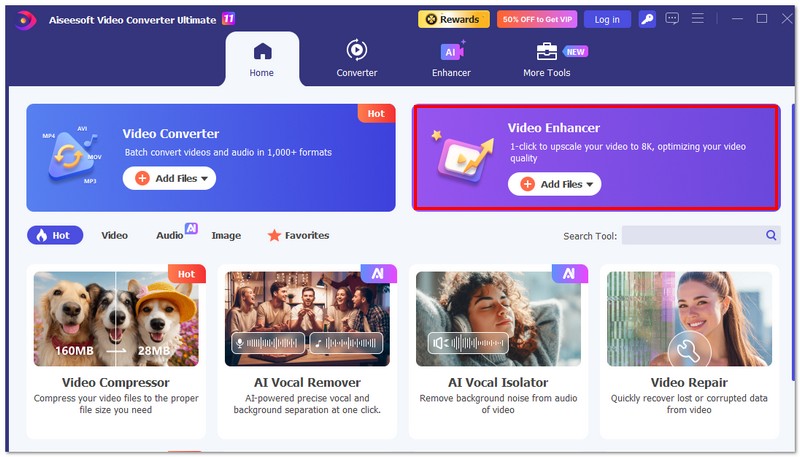
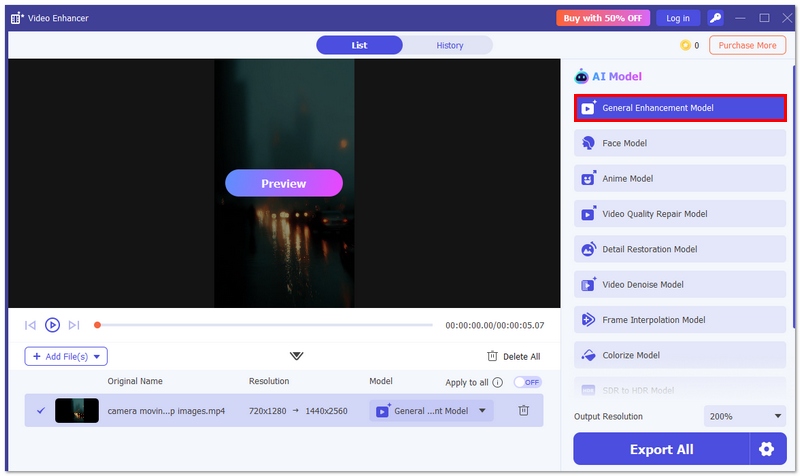
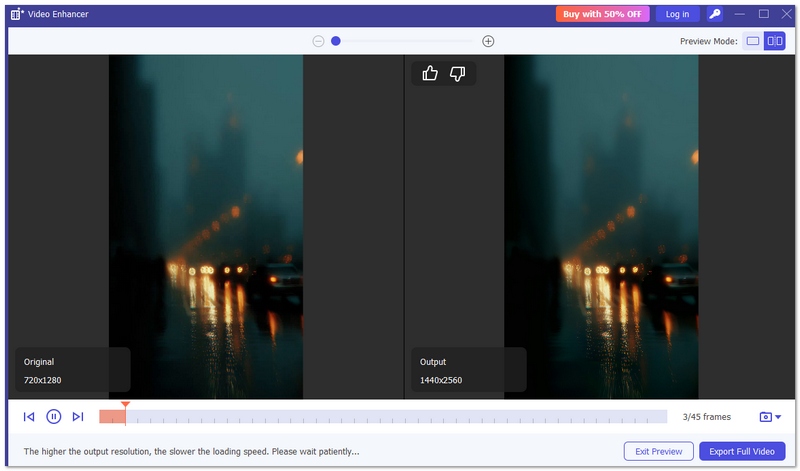
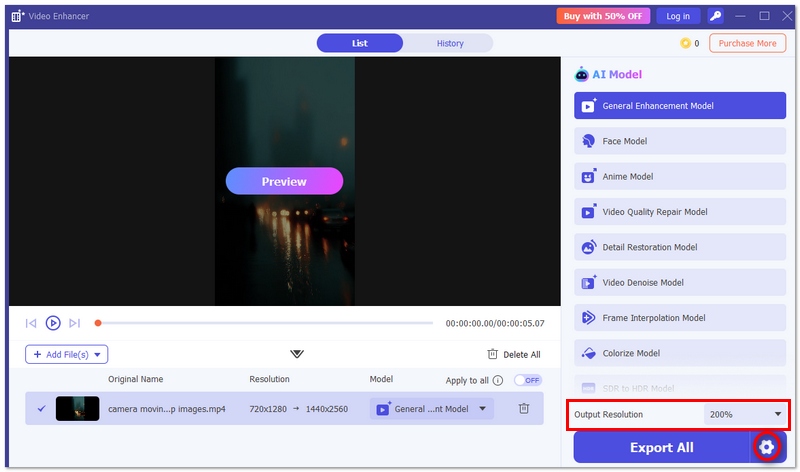
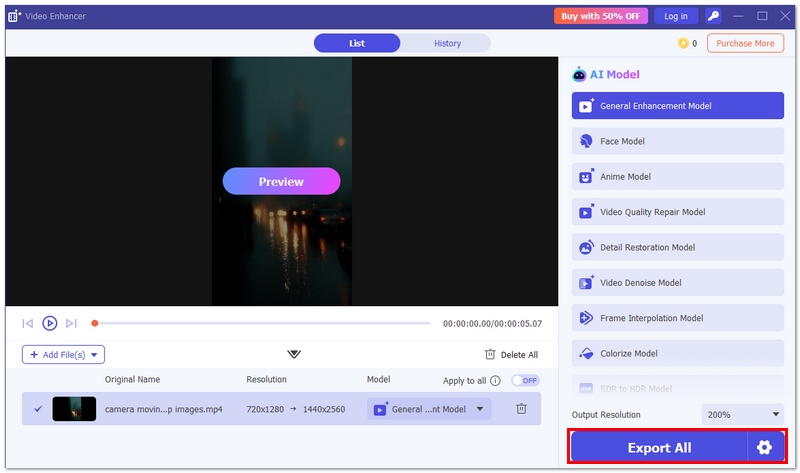
If you need a quick and effective method to repair interlaced video, Aiseesoft Video Converter Ultimate offers an AI powered feature that can automatically enhance video quality. Rather than turning the knobs on complex encoding settings by yourself, this software employs advanced video enhancement technology to transform interlaced clips into more fluid progressive ones. It is suitable for beginners, content creators, and users who need fast processing with high output quality.
Downloads
100%
Secure. No Ads.
100%
Secure. No Ads.
Steps to Deinterlace Video with AI Video Enhancer
Using FFmpeg to deinterlace requires some tech knowledge, so for users who want to deinterlace video using a free open-source tool, VLC Media Player is one of the most popular media players around the world. It is not only an open-source project, but also a video editor. Similar to other open-source projects, VLC hides extensive features in the menu. That is why most users cannot grasp all features, like the built-in Deinterlace. VLC has the capacity to analyze the interlaced video and correct it.
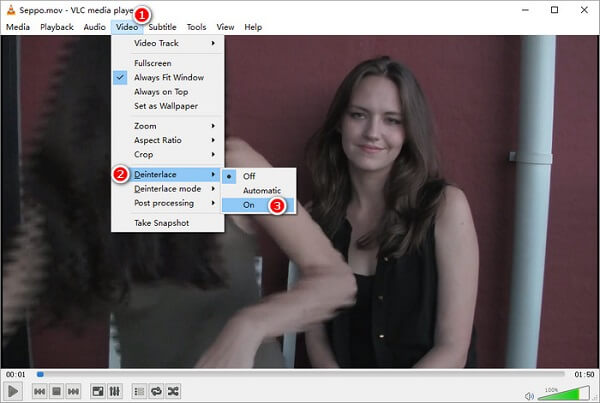
VLC will not change your video, and the VLC's Deinterlace feature will only modify the display of interlaced videos. It means that you have to turn on the Deinterlace feature next time when you view the interlaced video in VLC. Moreover, you will still see the mice's teeth when playing the video on other devices or your smartphone.
Another way to deinterlace videos is Handbrake. It is another open-source project for Windows users (check here for Handbrake for Mac), so you can process your interlaced videos for free. Unlike VLC, Handbrake will edit the video and replace the original file. Plus, this video application is a bit complicated. You can follow the steps below to achieve the task.
You'd better make a copy to your video file. Once Handbrake crashes during the process or the output is poor, your video will not be damaged.
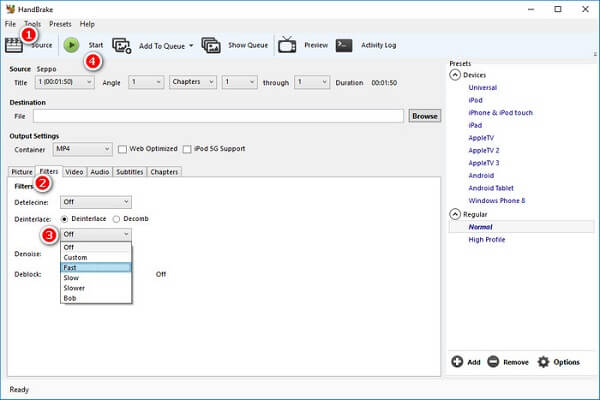
Note: Though Handbrake is powerful enough to deinterlace a video, it is not the best option for beginners. Moreover, some users complained about the poor output quality. Handbrake does not offer the preview window, so you do not know the result until the process is done. To be honest, Handbrake is not suitable to deal with long videos, because it takes much longer time to process a video and even possibly crashes. The complicated operation is another downside of Handbrake's Deinterlace feature.
See how to uninstall HandBrake on Mac here.
What are common problems with deinterlacing?
Common problems include loss of vertical resolution, ghosting, blurring, or uneven motion. Choosing the wrong method or using automatic deinterlacing without consideration of content can result in jerky or visually degraded video.
Does deinterlacing affect file size?
Deinterlacing itself does not inherently increase file size, but if the process doubles frame rates or outputs higher-resolution frames, the resulting file can be larger due to more frames being stored.
Can deinterlacing be reversed?
No, deinterlacing is generally irreversible because the original interlaced fields are merged or discarded during processing. Once combined into progressive frames, the precise original field information is lost.
Conclusion
In this post, we explored the basics of deinterlacing and showed you how to deinterlace video using three practical methods. Tools like Aiseesoft Video Converter Ultimate offer an easy and high-quality solution, while VLC provides a quick playback fix, and HandBrake gives more control for advanced users. By choosing the right method based on your needs, you can remove interlacing artifacts and enjoy smoother, clearer video playback. If you still have questions, feel free to leave a comment below.
 Top Audio Enhancer Review
What is the best audio enhancer to make pleasure? Read this post to get the best one from DFX Audio Enhancer, Free Audio Editor and Breakaway Audio Enhancer.
 7 Popular Video Denoiser to Use to Remove Video Noises [Newly]
Video denoiser is a popular feature that you can use on most video editors. But not all have the most effective way to denoise video. That is why we created this article.
 How to Optimize Video Brightness and Contrast Professionally
How to Optimize Brightness and Contrast of Your Video? With professional video enhancer software, you can optimize video brightness and contrast in one click.
 Leave your comment and join our discussion
Video Converter Ultimate is excellent video converter, editor and enhancer to convert, enhance and edit videos and music in 1000 formats and more.
100% Secure. No Ads.
100% Secure. No Ads.

*Required field
*Please enter a valid email